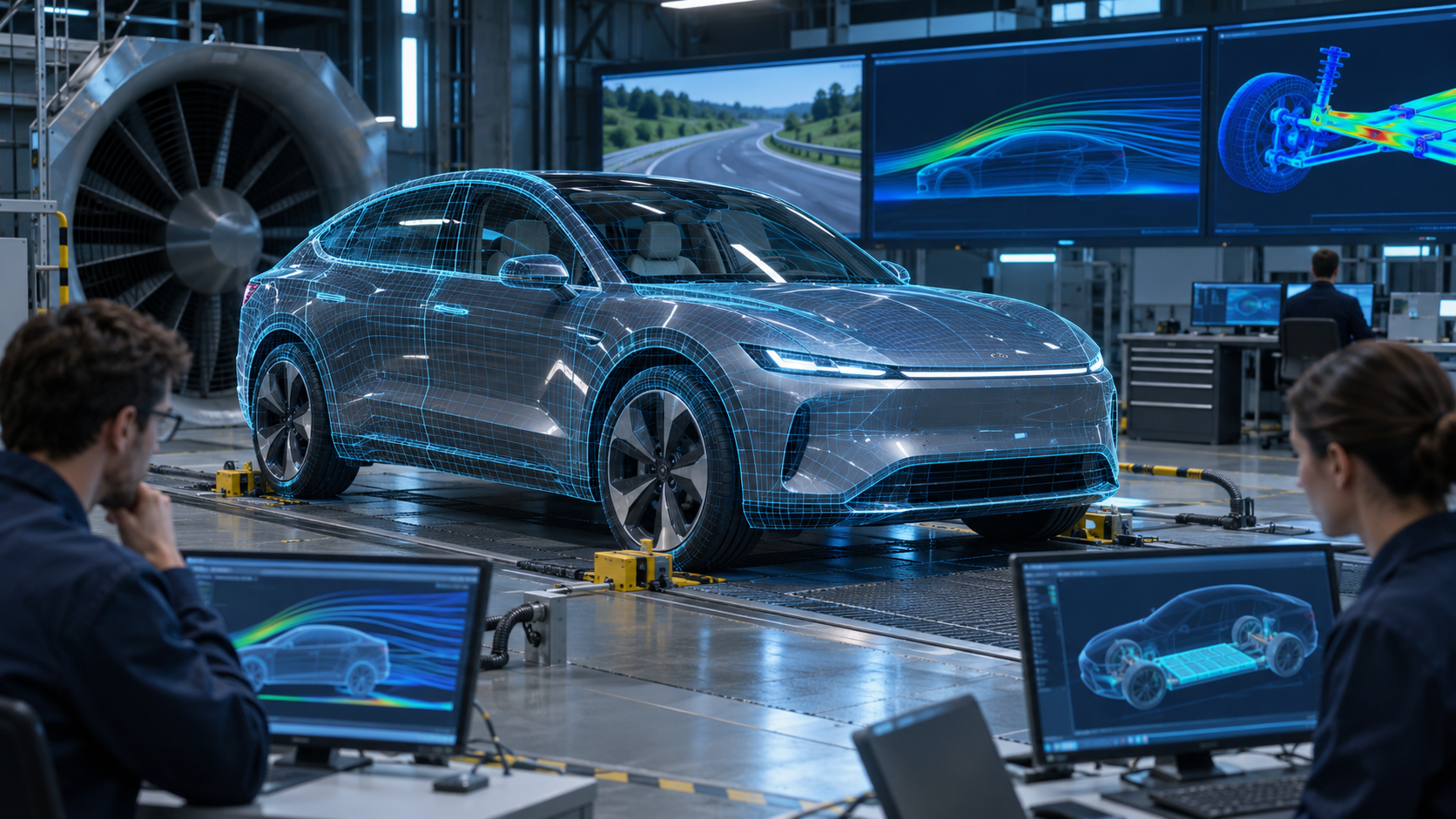

What is vehicle dynamics simulation, and how can a digital model help engineers predict how a real vehicle will ride, steer, brake, and respond?
Vehicle dynamics simulation becomes easier to plan when the team starts with the decision, audience, evidence, and delivery conditions. The tools matter, but they do not replace a clear brief or a review process that catches problems early.
This guide is written for vehicle engineers, simulation teams, suppliers, validation leaders, and mobility programme managers. It explains the workflow in practical terms and links each stage to traceable evidence about vehicle behavior that guides design choices and focuses physical testing on the questions that still need real hardware. Explore Mimic Mobility for services, project examples, and related production guidance.
Table of Contents
What Is Vehicle Dynamics Simulation?
Vehicle dynamics simulation uses mathematical models to predict how a vehicle moves and responds to steering, braking, acceleration, road inputs, wind, loads, and control commands. Models may cover one component, a subsystem, or a complete vehicle.
The model is useful only within a defined purpose and operating range. A simple model can answer an early architecture question, while limit handling or ride comfort may require detailed tire, suspension, body, driver, and road representations.
A practical review separates the intended result from the method used to reach it. For vehicle engineers, simulation teams, suppliers, validation leaders, and mobility programme managers, that means checking the source material, assumptions, responsibilities, intermediate approvals, and delivery conditions before scaling the work. Early evidence is cheaper to change than a nearly finished output.
Record the decision behind each approval and test the work in the context where it will be used. This helps the team distinguish a creative preference from a technical failure, missing input, or change in scope. Read a related Mimic Mobility guide for another part of the workflow.
Good review notes describe what is wrong, where it appears, why it matters, and what a successful revision should achieve. They avoid broad reactions that force the team to guess. When several stakeholders are involved, one person should consolidate feedback, resolve contradictions, and confirm which comments are required before the next stage begins.
Before moving on, confirm the owner, inputs, expected output, review method, known limits, and one test that would reveal a weak result. That short check keeps effort focused on traceable evidence about vehicle behavior that guides design choices and focuses physical testing on the questions that still need real hardware.
Which Vehicle Systems Are Modelled?
Typical models represent mass and inertia, tires, suspension geometry, springs, dampers, bushings, steering, brakes, powertrain, aerodynamics, body flexibility, road surfaces, drivers, and electronic controls.
Each subsystem adds parameters and uncertainty. Teams should record where the values came from, which conditions they cover, and how sensitive the result is to measurements that are incomplete or variable.
A practical review separates the intended result from the method used to reach it. For vehicle engineers, simulation teams, suppliers, validation leaders, and mobility programme managers, that means checking the source material, assumptions, responsibilities, intermediate approvals, and delivery conditions before scaling the work. Early evidence is cheaper to change than a nearly finished output.
Record the decision behind each approval and test the work in the context where it will be used. This helps the team distinguish a creative preference from a technical failure, missing input, or change in scope. Read a related Mimic Mobility guide for another part of the workflow.
Good review notes describe what is wrong, where it appears, why it matters, and what a successful revision should achieve. They avoid broad reactions that force the team to guess. When several stakeholders are involved, one person should consolidate feedback, resolve contradictions, and confirm which comments are required before the next stage begins.
Before moving on, confirm the owner, inputs, expected output, review method, known limits, and one test that would reveal a weak result. That short check keeps effort focused on traceable evidence about vehicle behavior that guides design choices and focuses physical testing on the questions that still need real hardware.
How Does a Vehicle Dynamics Simulation Workflow Run?
The team starts with a requirement or decision, selects model fidelity, defines maneuvers and conditions, runs simulations, calculates metrics, compares alternatives, and records the result. Repeatable automation helps expose regressions after a design change.
Useful workflows keep model versions, parameter sets, scenario definitions, solver settings, and output scripts together. Without that traceability, a convincing plot may be impossible to reproduce or review.
A practical review separates the intended result from the method used to reach it. For vehicle engineers, simulation teams, suppliers, validation leaders, and mobility programme managers, that means checking the source material, assumptions, responsibilities, intermediate approvals, and delivery conditions before scaling the work. Early evidence is cheaper to change than a nearly finished output.
Record the decision behind each approval and test the work in the context where it will be used. This helps the team distinguish a creative preference from a technical failure, missing input, or change in scope. Read a related Mimic Mobility guide for another part of the workflow.
Good review notes describe what is wrong, where it appears, why it matters, and what a successful revision should achieve. They avoid broad reactions that force the team to guess. When several stakeholders are involved, one person should consolidate feedback, resolve contradictions, and confirm which comments are required before the next stage begins.
Before moving on, confirm the owner, inputs, expected output, review method, known limits, and one test that would reveal a weak result. That short check keeps effort focused on traceable evidence about vehicle behavior that guides design choices and focuses physical testing on the questions that still need real hardware.
Which Maneuvers and Scenarios Are Tested?
Common scenarios include steady-state cornering, step steer, sine with dwell, lane changes, braking in a turn, split-friction braking, rough-road inputs, crosswinds, hill starts, and combined acceleration and steering.
A scenario needs exact initial conditions, driver inputs, road properties, load state, environment, controls, and acceptance metrics. Small differences can change the result and make comparisons misleading.
A practical review separates the intended result from the method used to reach it. For vehicle engineers, simulation teams, suppliers, validation leaders, and mobility programme managers, that means checking the source material, assumptions, responsibilities, intermediate approvals, and delivery conditions before scaling the work. Early evidence is cheaper to change than a nearly finished output.
Record the decision behind each approval and test the work in the context where it will be used. This helps the team distinguish a creative preference from a technical failure, missing input, or change in scope. Read a related Mimic Mobility guide for another part of the workflow.
Good review notes describe what is wrong, where it appears, why it matters, and what a successful revision should achieve. They avoid broad reactions that force the team to guess. When several stakeholders are involved, one person should consolidate feedback, resolve contradictions, and confirm which comments are required before the next stage begins.
Before moving on, confirm the owner, inputs, expected output, review method, known limits, and one test that would reveal a weak result. That short check keeps effort focused on traceable evidence about vehicle behavior that guides design choices and focuses physical testing on the questions that still need real hardware.
How Are Drivers and Control Systems Included?
Driver models can follow paths, regulate speed, react to disturbances, or reproduce measured behavior. Control models may include ABS, stability control, torque vectoring, active suspension, steering assistance, and powertrain responses.
Closed-loop tests are important because the driver and controllers change the vehicle state. A model that behaves well under a fixed input may produce a different outcome when the control system reacts.
A practical review separates the intended result from the method used to reach it. For vehicle engineers, simulation teams, suppliers, validation leaders, and mobility programme managers, that means checking the source material, assumptions, responsibilities, intermediate approvals, and delivery conditions before scaling the work. Early evidence is cheaper to change than a nearly finished output.
Record the decision behind each approval and test the work in the context where it will be used. This helps the team distinguish a creative preference from a technical failure, missing input, or change in scope. Read a related Mimic Mobility guide for another part of the workflow.
Good review notes describe what is wrong, where it appears, why it matters, and what a successful revision should achieve. They avoid broad reactions that force the team to guess. When several stakeholders are involved, one person should consolidate feedback, resolve contradictions, and confirm which comments are required before the next stage begins.
Before moving on, confirm the owner, inputs, expected output, review method, known limits, and one test that would reveal a weak result. That short check keeps effort focused on traceable evidence about vehicle behavior that guides design choices and focuses physical testing on the questions that still need real hardware.
How Is a Vehicle Dynamics Model Validated?

Validation compares simulation outputs with trusted calculations, component rigs, kinematics and compliance tests, proving-ground maneuvers, road measurements, and known reference vehicles.
Correlation is not a single score. Teams examine timing, phase, peaks, steady-state values, frequency behavior, temperature, repeatability, and the uncertainty in both the model and the measurement.
A practical review separates the intended result from the method used to reach it. For vehicle engineers, simulation teams, suppliers, validation leaders, and mobility programme managers, that means checking the source material, assumptions, responsibilities, intermediate approvals, and delivery conditions before scaling the work. Early evidence is cheaper to change than a nearly finished output.
Record the decision behind each approval and test the work in the context where it will be used. This helps the team distinguish a creative preference from a technical failure, missing input, or change in scope. Read a related Mimic Mobility guide for another part of the workflow.
Good review notes describe what is wrong, where it appears, why it matters, and what a successful revision should achieve. They avoid broad reactions that force the team to guess. When several stakeholders are involved, one person should consolidate feedback, resolve contradictions, and confirm which comments are required before the next stage begins.
Before moving on, confirm the owner, inputs, expected output, review method, known limits, and one test that would reveal a weak result. That short check keeps effort focused on traceable evidence about vehicle behavior that guides design choices and focuses physical testing on the questions that still need real hardware.
Frequently Asked Questions
Is vehicle dynamics simulation the same as a driving simulator?
No. A driving simulator places a person in the loop. Vehicle dynamics simulation can run without a human and may focus on components, controls, maneuvers, or automated design studies.
What is a full-vehicle model?
It is a connected representation of the vehicle body, wheels, tires, suspension, steering, brakes, powertrain, aerodynamics, controls, and relevant environment.
Why are tire models important?
Tires create the forces that connect the vehicle to the road. Their nonlinear behavior, load sensitivity, temperature, pressure, wear, and surface conditions strongly affect results.
Can simulation predict ride comfort?
It can estimate responses to road inputs, but credible comfort work also needs representative road data, seat and body paths, frequency measures, and human evaluation.
What is model fidelity?
Fidelity is the level of behavior needed for a specific question. More detail adds cost and parameters and is useful only when it improves the decision.
How is simulation used before a prototype exists?
Teams compare architectures, dimensions, mass properties, suspension concepts, control strategies, and target values using estimated or supplier data.
Can vehicle dynamics simulation replace track testing?
It can reduce and focus track work, but final correlation, safety, driver perception, durability, and regulatory evidence still require physical tests.
What data is needed to build a model?
Inputs may include geometry, mass and inertia, tire data, spring and damper curves, bushing compliance, steering ratios, brake data, aerodynamics, controls, and road profiles.
How are simulation results reviewed?
Reviewers check requirements, model versions, inputs, scenario definitions, plots, metrics, sensitivity, correlation evidence, and known limitations.
When should vehicle dynamics simulation begin?
It should begin during target setting and concept work, then mature as measurements, components, controls, prototypes, and test evidence become available.
Conclusion
Vehicle dynamics simulation works best when creative ambition and practical planning support each other. Define the result, gather the right inputs, review important decisions early, and keep the final use in view throughout production.
If you are planning a related project, contact Mimic Mobility to discuss the brief, schedule, workflow, review stages, and required deliverables.