
Can autonomous vehicle simulation replace real-world testing?
Not completely. Autonomous vehicle simulation can move much of development, safety exploration, regression testing, and rare-event analysis into a controlled virtual environment. It lets engineers run repeatable experiments at speed without putting people or costly prototypes at risk. But a simulator remains a model of reality, and every model has boundaries.
The strongest validation strategy combines virtual evidence with laboratory, proving-ground, and carefully governed road tests. This guide answers how self-driving cars are tested, where simulation creates the most value, where it can mislead, and how mobility teams can build a defensible hybrid validation plan.
Table of Contents
Can Simulation Replace Real-World AV Testing?
Simulation can replace a test activity when the virtual model, test interface, and measurement process are credible for the specific decision being made. It is excellent for discovering software defects, comparing algorithms, exploring parameter boundaries, replaying recorded events, and checking whether a new release has broken previously working behavior. These are repeatable questions with explicit inputs and outputs.
It cannot independently prove that the complete vehicle is safe in every real operating condition. Cameras respond to real light, lenses collect dirt, radar reflects from physical materials, tires interact with changing surfaces, compute systems experience timing and thermal effects, and people behave in surprising ways. If those effects are absent or modeled poorly, a passing virtual result may create false confidence.
The useful answer is therefore not simulation or road testing. It is simulation first, physical confirmation where uncertainty matters, and continuous feedback between both. Every physical anomaly should improve the scenario library. Every important virtual failure should guide a focused physical check. This loop makes limited road-test time more informative.
Teams should begin with the system’s operational design domain and safety claims. The useful target is measured coverage of requirements, hazards, ODD conditions, parameter boundaries, and known failure modes—not an impressive count of virtual runs or miles.
For a practical framework, read Mimic Mobility’s guide to how many AV simulation scenarios are needed.
What Autonomous Vehicle Simulation Does Best
Autonomous vehicle simulation is most powerful when teams need scale, control, repeatability, and safe access to dangerous situations. A single logical scenario—such as a pedestrian emerging from behind a parked van—can become thousands of concrete tests by varying speed, occlusion, clothing, lighting, road friction, reaction timing, sensor noise, and vehicle state.
That variation helps engineers locate performance boundaries instead of collecting only average behavior. It also makes failures reproducible. A road event may never recur with the same actors, weather, timing, and geometry, while a simulator can replay the decisive instant until the root cause is understood and a fix is verified.
Rare and hazardous events can be explored without exposing people or expensive prototypes to danger.
A consistent regression library can run against every software build and reveal unexpected changes.
Coverage can be mapped to requirements, hazards, ODD conditions, parameter boundaries, and failure modes.
Changing one factor at a time helps isolate cause and effect before systematic sampling explores interactions.
Synthetic sensor data and reconstructed real events can supplement scarce examples when limitations remain visible.
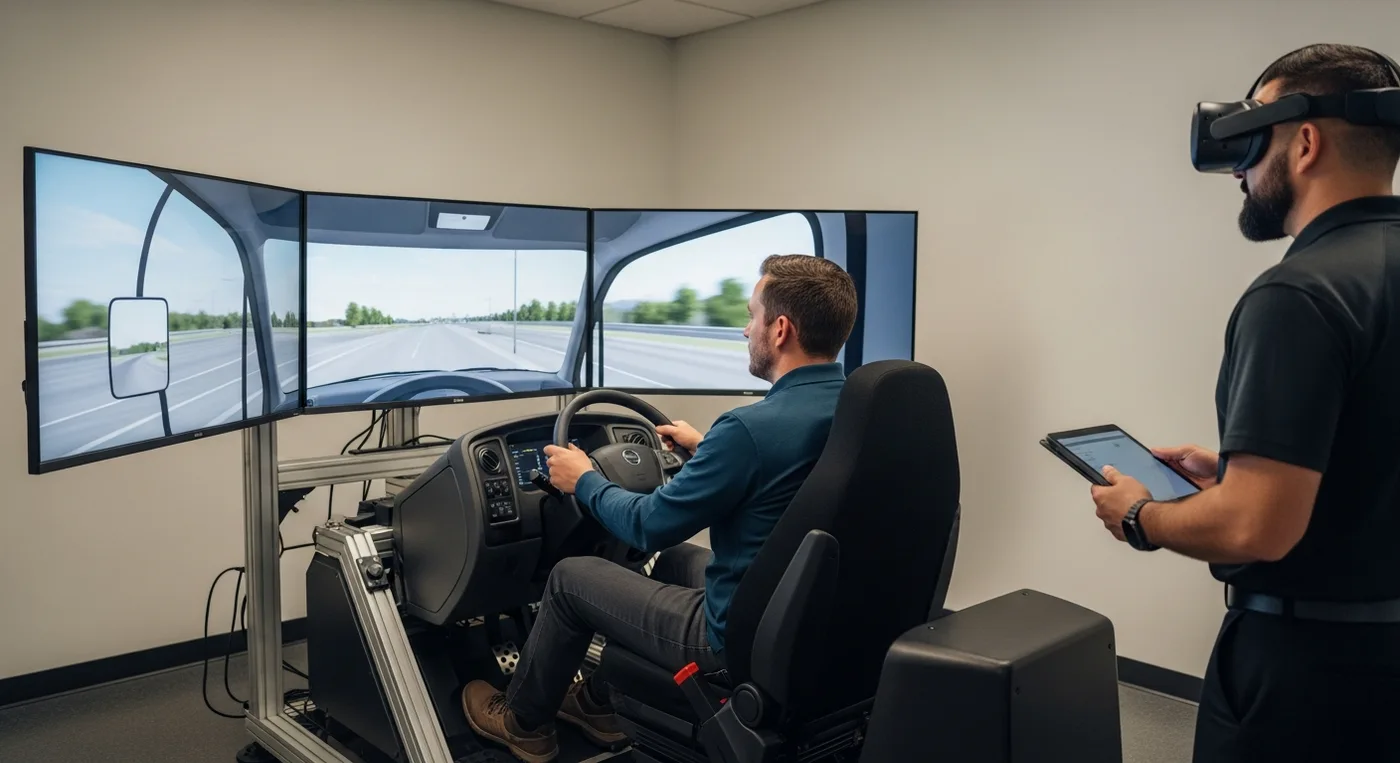
Immersive environments can evaluate driver handover, interface comprehension, passenger comfort, and attention.
Mimic Mobility creates photo-realistic 3D simulation environments for mobility that support training, visualization, virtual prototyping, integration, and design exploration.
Where Virtual Testing Falls Short
A simulator can be internally consistent and still be wrong about the world. This is the central sim-to-real risk. Visual fidelity is only one part of credibility. A beautiful scene may have inaccurate material reflectance, simplified sensor physics, unrealistic traffic agents, optimistic latency, or vehicle dynamics that do not match the production platform.
Model fidelity should be judged against the purpose of the test. A route-planning study may not require millimeter-accurate tire behavior. An emergency-control claim may require detailed dynamics, actuator delay, road friction, and load transfer. A perception claim may depend on camera response, radar signatures, lidar returns, weather, lens contamination, glare, and the long tail of objects found on real roads.
Behavior modeling is another boundary. Traffic participants do not follow perfect scripts. They negotiate informally, hesitate, violate rules, hide intent, and react to local customs. Scenario parameters can represent variation, but physical observation is needed to keep those distributions grounded.
Teams should also prevent overfitting to a familiar test library. Independent scenario ownership, hidden evaluation sets, mutation testing, new field data, and periodic challenge exercises reduce the risk that developers optimize for known examples instead of the underlying safety problem.
A credible program documents assumptions, calibration data, validity ranges, uncertainty, known mismatches, and model change control. Passing results outside a validated range should never be treated as strong safety evidence.
See Mimic Mobility’s ADAS simulation testing and validation plan for a broader implementation view.
How Are Self-Driving Cars Tested in Practice?
Self-driving cars are tested through layers. Each layer answers different questions, and confidence grows when evidence remains traceable as the system moves toward the physical world. The sequence is not strictly one-way; failures at any level should send teams back to models, requirements, or scenarios.
Model-in-the-loop testing evaluates algorithms and simplified plant models early, when changes are inexpensive.
Software-in-the-loop testing runs production-intent software against simulated vehicles, sensors, traffic, and environments.
Hardware-in-the-loop testing connects real compute hardware, control units, networks, or sensors to a simulated world.
Driver- or vehicle-in-the-loop testing combines physical controls or a real vehicle with virtual stimuli.
Closed-course and proving-ground tests confirm critical maneuvers in controlled physical settings.
Shadow-mode or supervised fleet collection observes real traffic and compares what the system would have done.
Governed public-road testing evaluates integrated behavior in the intended environment with monitoring and fallback.
Promotion criteria should be explicit. A build might move from software-in-the-loop to hardware-in-the-loop only after required scenarios pass, critical regressions close, coverage targets are met, and model validity is current. Physical tests should concentrate on uncertainties simulation cannot resolve efficiently.
When a road test produces a disengagement, near miss, confusing interaction, or sensor anomaly, the event should be reconstructed, generalized into a scenario family, added to regression testing, and linked to the software change that resolves it. That turns one field observation into durable organizational learning.
Explore Mimic Mobility’s foundational autonomous vehicle simulation validation guide for scenario, model, and evidence planning.
How to Build a Defensible Hybrid Validation Plan
Begin with claims, not tools. State what the function should do, where it may operate, which hazards matter, what safe fallback means, and which evidence would support each claim. Define the ODD in testable terms: roads, speeds, geometry, weather, lighting, traffic, connectivity, map quality, vehicle state, and human responsibilities.
Create scenario families from requirements, hazard analysis, field data, crash and near-miss patterns, expert review, foreseeable misuse, and boundary conditions. Separate functional scenarios in plain language from logical scenarios with parameter ranges and concrete executable tests. Give each scenario an owner, source, purpose, version, expected result, and link to the relevant claim.
Allocate each test to the lowest-cost level that can answer the question credibly. Use simulation for scale, rare hazards, exploration, and regression. Use hardware tests for timing and interfaces. Use proving grounds for physical response. Use public-road exposure for environmental diversity and interactions that cannot yet be modeled with confidence.
Define pass criteria before running the test. Useful measures include collisions, near collisions, time to collision, braking margin, lane deviation, rule compliance, perception precision and recall, localization error, comfort, fallback success, repeatability, and model-to-road correlation. Averages can hide unsafe tails, so inspect distributions and worst credible cases.
Calibrate simulation models with measured vehicle, sensor, map, weather, and traffic data.
Run matched virtual and physical cases, quantify error, and define validity ranges.
Track the exact software, hardware, map, model, scenario, and configuration behind every result.
Require regression after changes to code, sensors, compute, calibration, maps, dynamics, or the ODD.
Record uncertainty and residual risk rather than converting every result into a simplistic pass or fail.
Use independent review for safety-critical claims, scenario completeness, model credibility, and promotion decisions.
Mimic Mobility’s visualization and planning capabilities can turn abstract requirements into understandable environments for engineering and stakeholder review.
Autonomous Vehicle Simulation FAQs
Can autonomous vehicle simulation replace road testing?
No. It can replace many early, repetitive, dangerous, and regression tests, but physical testing remains necessary to validate dynamics, sensors, integration, human interaction, and performance in the intended environment.
Why is simulation important for autonomous vehicles?
It makes testing safe, repeatable, scalable, and measurable. Teams can reproduce rare hazards, vary one parameter at a time, compare releases, and run far more cases than a physical fleet can encounter economically.
What is an autonomous vehicle simulation scenario?
A scenario describes road geometry, actors, behavior, environment, sensor conditions, vehicle state, and an expected safety outcome. Parameter ranges turn a logical scenario into many concrete runs.
What is the sim-to-real gap?
It is the difference between a virtual model and the physical world, caused by imperfect sensor, material, lighting, weather, dynamics, traffic-behavior, timing, map, or software assumptions.
Which AV edge cases should be simulated?
Priorities include unusual cut-ins, occlusion, emergency vehicles, vulnerable road users, poor markings, low sun, rain, fog, construction, sensor faults, localization errors, and fallback events tied to the ODD.
How do you know a simulator is accurate enough?
Validate models against measured data, define decision-specific tolerances, compare matched virtual and physical tests, track uncertainty, and revalidate after meaningful changes.
What metrics matter in AV testing?
Collision and near-collision rate, time to collision, braking margin, lane deviation, perception precision and recall, localization error, rule compliance, comfort, fallback success, coverage, and repeatability all matter.
How many simulation miles are enough?
There is no universal threshold. Scenario coverage, risk exposure, statistical confidence, model credibility, software configuration, and traceability matter more than a raw mileage total.
How can Mimic Mobility support AV simulation?
Mimic Mobility develops detailed real-time 3D environments, virtual prototypes, visualizations, and immersive experiences that help mobility teams communicate, explore, train, and validate concepts before expensive physical deployment.
Conclusion
Autonomous vehicle simulation does not eliminate the road; it makes every physical mile more purposeful. Virtual testing is the best environment for scale, repeatability, dangerous edge cases, rapid debugging, and continuous regression. Physical testing remains essential for confirming models, integrated hardware, sensor behavior, vehicle dynamics, human interaction, and the messy diversity of real mobility.
Planning an autonomous vehicle simulation or immersive mobility validation project? Explore Mimic Mobility’s 3D simulation capabilities and contact the team to turn your ODD, scenarios, and user experience into a focused validation roadmap.